Veteran Owned, Family Operated
 BASED ON 76 REVIEWS
Most basement leaks don't start as a puddle on the floor. They start as a hairline crack that's been letting water through for months before anyone notices. Here's what to actually look for, and what each sign tells you about what's happening inside your foundation wall.
Signs of a Basement Leak
Moisture at the cove joint. The cove is where your basement wall meets the floor slab. It's the weakest seam in the whole structure, because it's where two separately poured sections of concrete meet. If you're seeing dampness here, or along any basement wall crack, you're looking at seepage in the basement, and it tends to spread rather than dry up on its own.
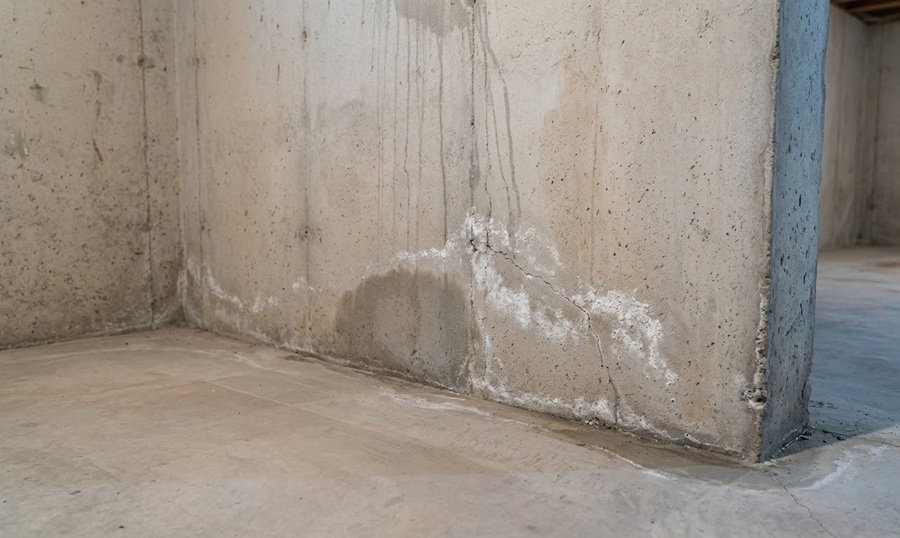
Efflorescence. The white, chalky coating you sometimes see on seeping basement walls isn't mold. It's mineral deposit: water moves through the concrete, carries dissolved salts to the surface, and leaves them behind when it evaporates. Home inspectors treat efflorescence and spalling as indicators tied directly to the moisture-management requirements written into the 2024 International Residential Code. The white residue is cosmetic. The water movement causing it isn't.
Brown or rust-colored staining. This is acid damage. Groundwater picks up acidic compounds from the surrounding soil and deposits them on the concrete as it seeps through, gradually breaking down the surface until it starts flaking or crumbling.
A crack that runs horizontal. Cracks along the horizontal mortar joints of a block foundation, especially mid-wall, usually mean the wall is being pushed on from the outside. A vertical crack is more often just settling or curing.
The foil test. Tape a piece of aluminum foil to the wall in an airtight seal and leave it for a couple of days. Moisture on the room-facing side means indoor humidity is condensing on a cold wall. Moisture on the wall side means it's a foundation leak coming from outside the house.
Musty smell or visible mold. Don't paint or caulk over it. Mold keeps growing underneath and eventually pushes the paint off the wall anyway.
Why the Health Angle Isn't an Exaggeration
The EPA lists mold exposure as a documented cause of allergic reactions, asthma flare-ups, and irritation of the eyes, skin, nose, throat, and lungs, in people with mold allergies and in people without them. It's the reason waterproofing companies exist as an industry.
Tennessee's Department of Health puts the practical threshold at 50% relative humidity for basements. Above that consistently, "watch it and see" stops being a reasonable plan. A $15 hygrometer tells you where you stand in about ten seconds.
If mold is already visible: soap and water first, then a diluted bleach solution, then dry completely. Anything beyond a small, contained patch is a job for a professional, not a weekend project.
What's Actually Causing the Leak
Basement water leak problems almost always trace back to hydrostatic pressure. A cubic foot of water weighs about 60 pounds. When the soil around your foundation gets saturated after heavy rain or snowmelt, that weight pushes outward against your basement wall from every direction at once.
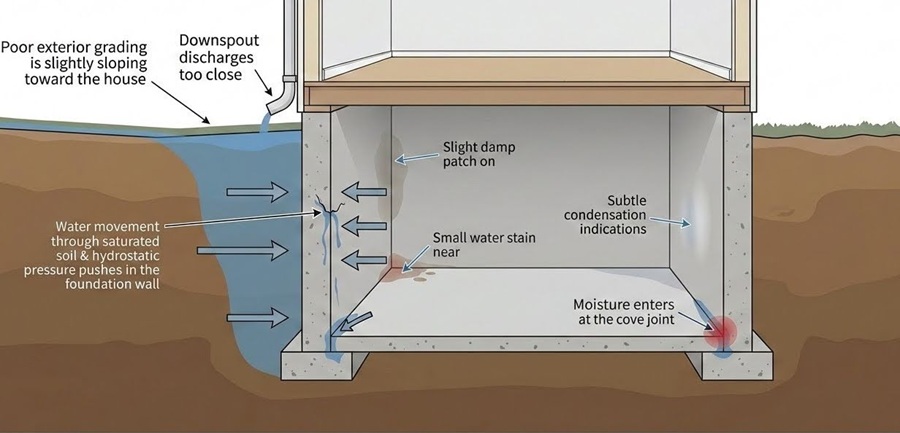
Concrete is porous by nature. Under enough sustained pressure, water gets through a crack if one exists, and eventually through the concrete itself if it doesn't. The pressure builds again with the next storm, which is why a leak that looked minor in June can be a bigger problem by September.
What to Do If Your Basement Leaks
Once you've determined you have a leak, the next thing to do is have your basement examined by a waterproofing expert who can explain the extent of the leak and the best way to remedy it. If you leave the problem untreated because it seems minor, or because you think you don't have the budget to fix it, remember that the problem won't just persist. It will get worse, and the cost of dealing with it will get worse along with it. Better to deal with a small leak now than a major one later.
Barry Antonelli, the Founder and President of Ameri-Dry® Systems, is a waterproofing expert who has dedicated three decades of his life to solving all types of basement, crawlspace, and foundation water problems.
He began his career in 1978, a time when aggressive companies and pushy salesmen were the norm, but quickly changed the face of the industry by instituting programs to empower the customer, including the industry's first Customer Relations Division, an independent Customer Service Department, and the industry's first Lifetime Warranty Program.
By the mid-1990s, Antonelli's company was waterproofing over 1,000 homes and structures every year, while still offering a Full Life-of-the-Structure Warranty. His commitment to customer service and to developing innovative techniques for solving wet basement, wet crawlspace, and foundation problems continues.
With over 30 years of basement waterproofing experience, Ameri-Dry offers patented, permanently dry systems backed by a full lifetime warranty.
We offer basement waterproofing, crawl space repair, and foundation repair. If you're seeing any of the signs above, schedule a free inspection: no obligation, no pressure, just a straight answer about what's actually going on in your basement.